Every serial ships with its record.
The bench that sizes your aircraft also builds the case for it. Design on validated physics, freeze the type, record each serial's conformity, and hand buyers a dossier with a code they can check.
14-day trial, no card, for up to 5 people and 3 registered aircraft.
What changes for your line
One tool from the first sizing to the dossier a buyer, a prime or a regulator asks for.
Numbers you can defend before you cut carbon.
Endurance, hover throttle, thrust margin and motor-out behavior recompute as you change a part, from published physics you can check.
A type you freeze, and serials that point back to it.
The design becomes a hashed type baseline. Each serial records its conformity against it, and bulletins fan out as per-serial work orders.
A dossier, not a promise.
One click renders the design dossier with a verification code anyone can check at rotorlab.app/verify, with no account.
The builder's bench
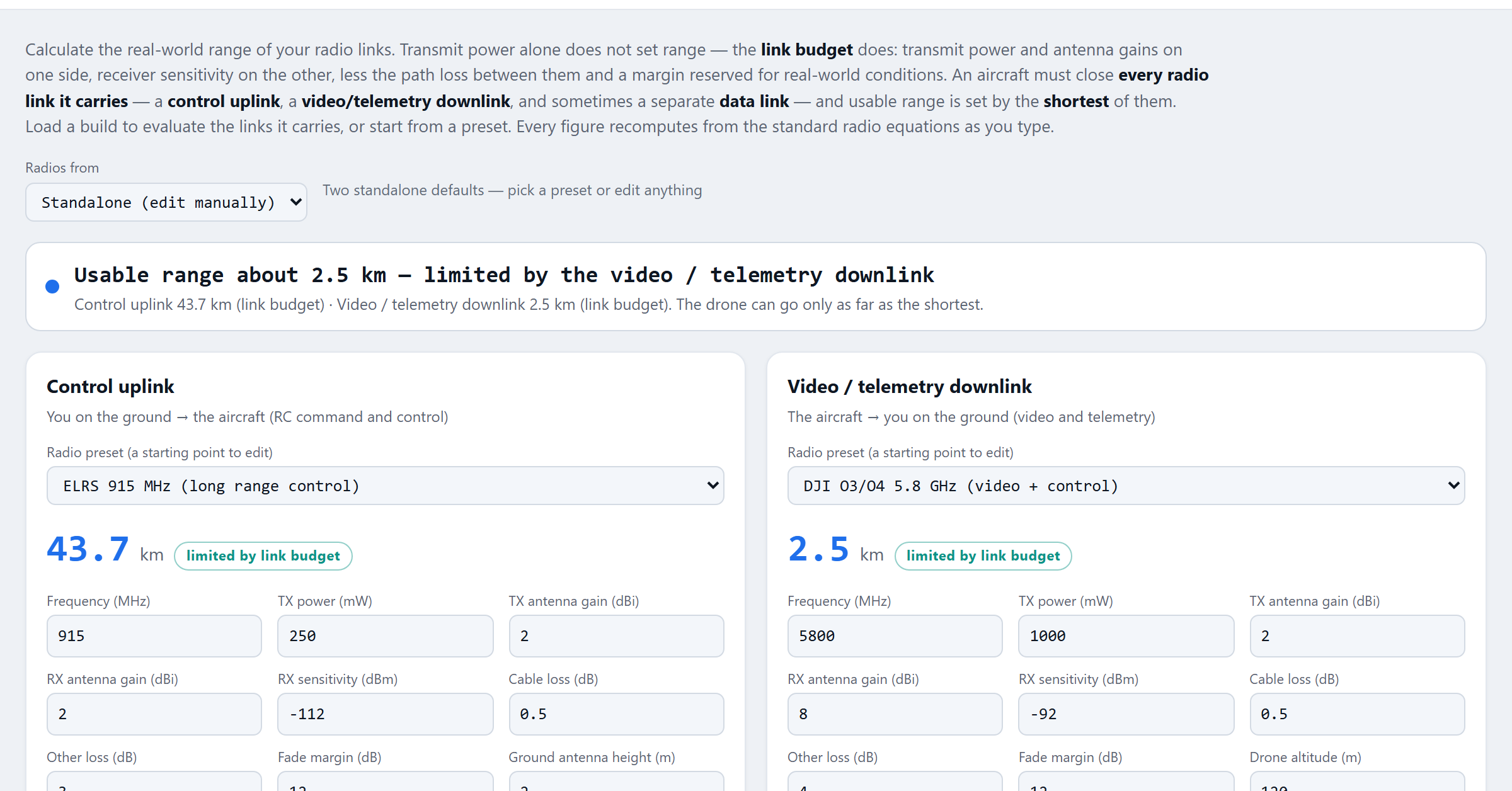
Mass and balance, radio range and the physics behind every number, measured where it can be measured.
From bench to baseline
Each step reads from the one before it, so nothing is typed twice.
Size it
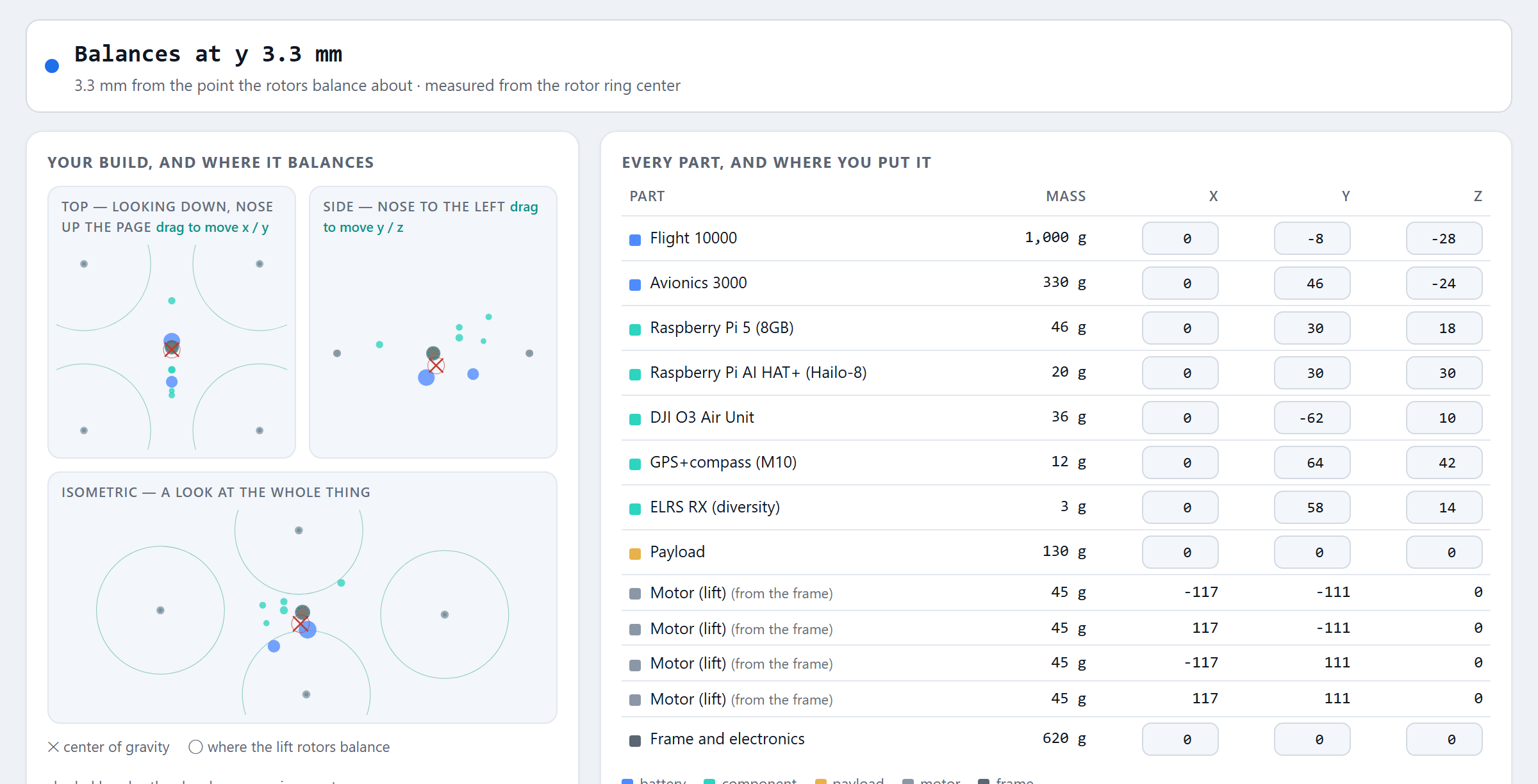
Frame, motors, propellers, packs and payload in the Builder, with a live physics readout. Calibrate from a bench hover so the numbers are the aircraft's own.
Freeze it
The design becomes a type baseline: the exact parameters and approved performance figures, hashed so nobody can quietly move them later.
Declare it
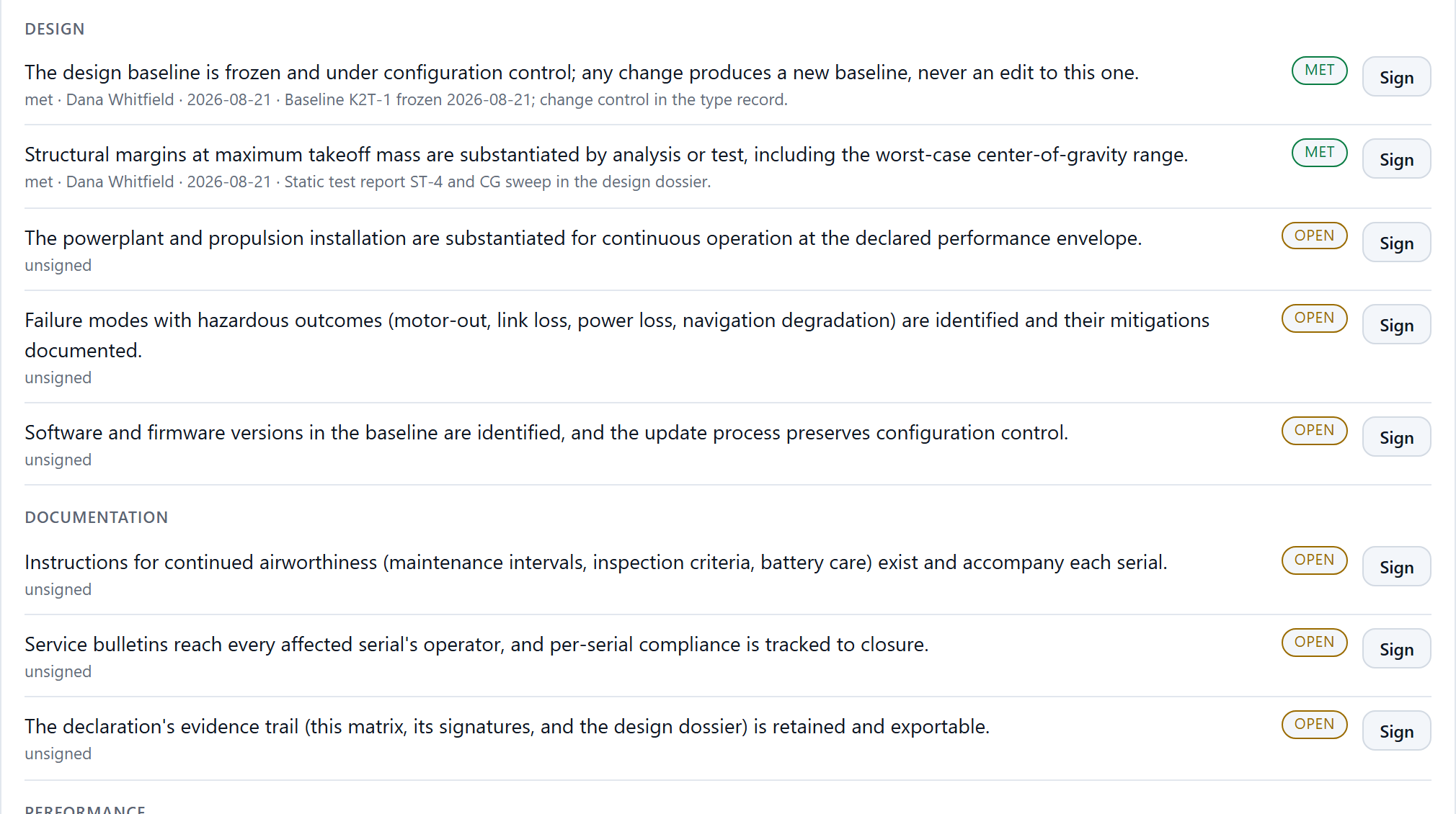
A requirement matrix lives on the type. Each item carries its evidence, its status and the name and date of the person who attested it.
Ship it
Every serial gets its conformity record against the baseline. Service bulletins become per-serial work orders with closure you can prove.
The day someone asks for your records is an easy day
The dossier carries the baseline, the declaration matrix with who attested each item and when, per-serial conformity and bulletin compliance. Its code is checked at rotorlab.app/verify, so your substantiation stands on its own the moment it leaves your hands.
Buyers already ask for substantiation
Where the aircraft came from and how you know it conforms. A records-first bench answers today's question; the FAA's proposed Part 108 is a proposal, not a rule in force.
Substantiation on demand
Your answer is a verifiable record set with its own code, built as a side effect of how you already work.
A records culture from day one
RotorLab seeds the requirement skeleton, the bulletin flow and the conformity records, so the discipline ships with the tooling.
Physics under every claim
The performance figures in your dossier come from a published, cross-checked engine, calibrated by measured hover telemetry.
RotorLab records your compliance program and makes it verifiable. It does not certify aircraft, and it never claims a regulator's authority, which is exactly what makes the records worth handing over.
The specifics
For the engineer who will check. The full guides are at docs.rotorlab.app.
The physics and its validation
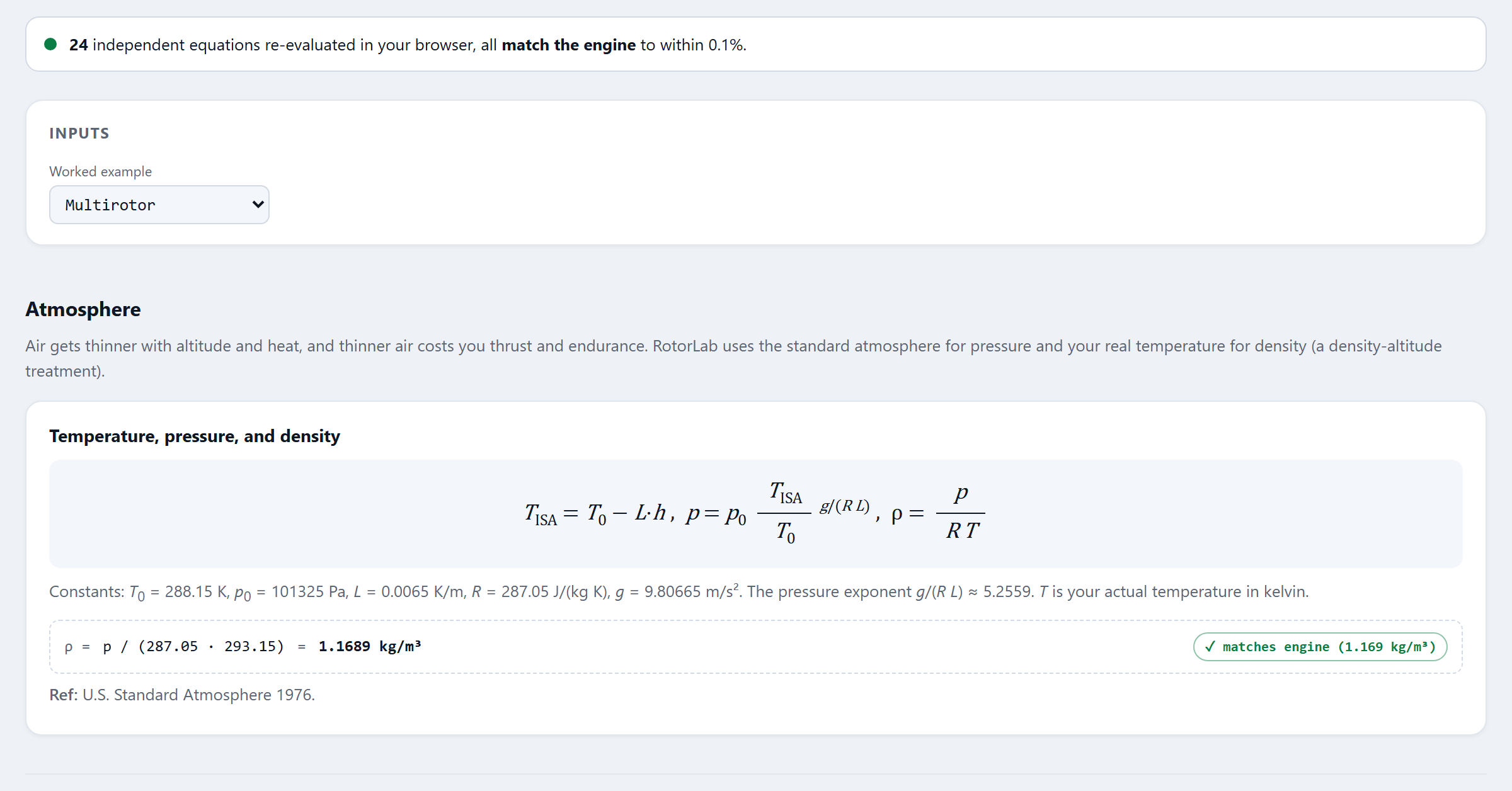
Thrust, endurance, hover margin and density altitude come from two dozen governing equations: hover from momentum theory, with motor, propeller and battery models from published data. The Math and Validation page re-runs every one of them in your browser and checks it against the engine to a tenth of a percent.
Bench-test telemetry calibrates the model to the aircraft you built: figure of merit is measured from a hover, and maximum thrust is inferred from the hover or measured when you add a thrust-stand file. Each figure carries its basis, so the dossier says which is which.
Types, serials and service bulletins
A frozen type holds the exact parameters and approved performance figures, hashed at freeze time. Each serialized aircraft gets a conformity record against the baseline; deviations need written notes. A service bulletin opens a work order on every affected serial, and the type record shows which serials have closed it.
The declaration matrix on the type lists each requirement with its evidence link, its status and the name and date of the person who attested it: a named record, not a digital signature. Marking a requirement met without evidence is not an option the software offers.
Continued airworthiness for your operators
The parts you name on the type, each with its life limit in hours, flights or months, reach every operator who links to your type with your code, as instructions for continued airworthiness. Each operator applies them to their own aircraft as components that count down on their records.
The dossier and how it is checked
The design dossier is a PDF with a verification code and a SHA-256 for its file. Anyone who holds it can enter the code at rotorlab.app/verify to see that RotorLab issued it, for which organization and when, and compare the file they hold byte for byte. Records are also timestamped daily by independent services; the Trust Center says how.
What this page needs: the Builder comes with every plan. Types, declarations, serials, bulletins and the dossier need Fleet Manager, priced per aircraft, and each serialized aircraft uses one Fleet Manager slot, unless Fleet Manager is bought per aircraft type where it is offered: then every serial of a covered type is registered without a slot. It is on during the 14-day trial, for up to 5 people and 3 registered aircraft. Prices are on the pricing page.
Your next aircraft can ship knowing its own story.
Freeze a type, attest a declaration and render a dossier before your trial is out. Running a fleet instead? Fleet operators have their own page.