RotorLab logoRotorLab
On your network

RotorLab TAK Fleet Server

One annual licence per server — add crews without adding licences

One server on your own network that speaks MAVLink to your aircraft and ground stations, publishes the whole fleet to ATAK, and records what happened. Switch on Fleet Server Cloud and it files every flight to RotorLab too.
Request a quote Read the full description
MAVLink HTTPS, enrolled CoT, live Fleet Server Cloud Your aircraft Ground stations Fleet Server on your network ATAK RotorLab.app
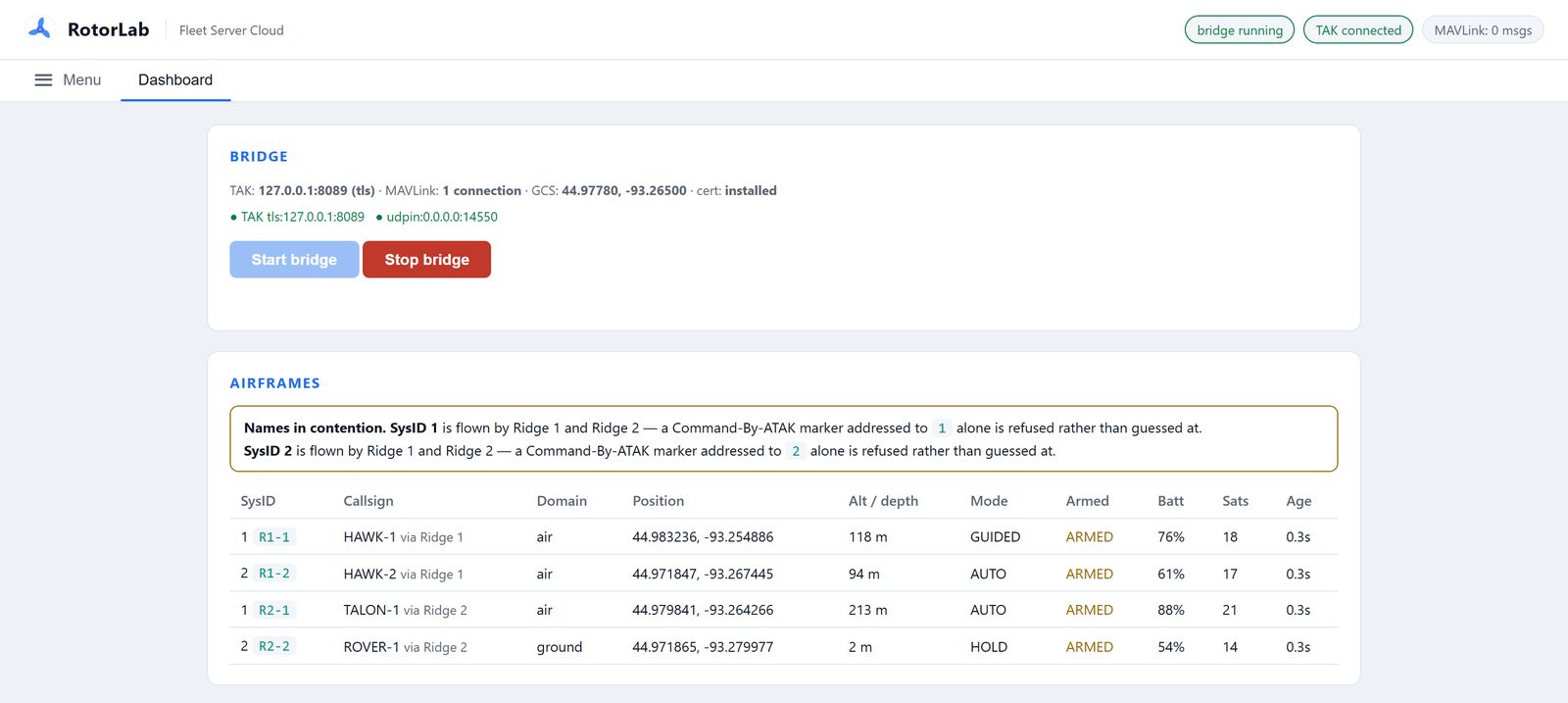
The Fleet Server dashboard: TAK connected, and an airframes table listing HAWK-1 and HAWK-2 via Ridge 1 alongside TALON-1 and ROVER-1 via Ridge 2, each with position, altitude, mode, armed state, battery and satellites.
Two crews, four vehicles, one server. Each aircraft carries its crew's address — R1-1, R2-2 — which is what an ATAK operator types to command it. When two crews fly the same SysID the server says so and refuses to guess.

What it does

The whole fleet on TAK

Every airframe published as a MIL-STD-2525 track — position, heading and the sensor footprint on the ground. Your crews get their own markers too, so the map shows who is where.

Command by ATAK

An approved operator tasks an aircraft by dropping a marker on the map. The ground station decides whether to carry it out — nothing here ever touches an autopilot directly.

Ground stations enroll

A station joins with a code somebody types once, then dials out over TLS. No inbound ports, works across NAT, and any station can be revoked instantly by name.

It is the buffer

A ground station hands over a finished flight and is done. Whether RotorLab is reachable is the server's problem, never the pilot's and never the aircraft's — a durable outbox replays everything when the link returns.

Every run is recorded

Each session is written to an append-only, hash-chained record. Replay the fleet picture at any moment of a call, and re-verify that the recording has not been altered since.

It is the cache

Roster, registry and checklists are pulled from RotorLab and served from the local copy, so a crew picking a pilot and an aircraft never waits on an internet round trip. Stale but present beats absent.

It holds the only key

The one credential lives here, on a server in your building. Nothing downstream — not a ground station, not a vehicle, not the aircraft — carries anything that opens your RotorLab account.
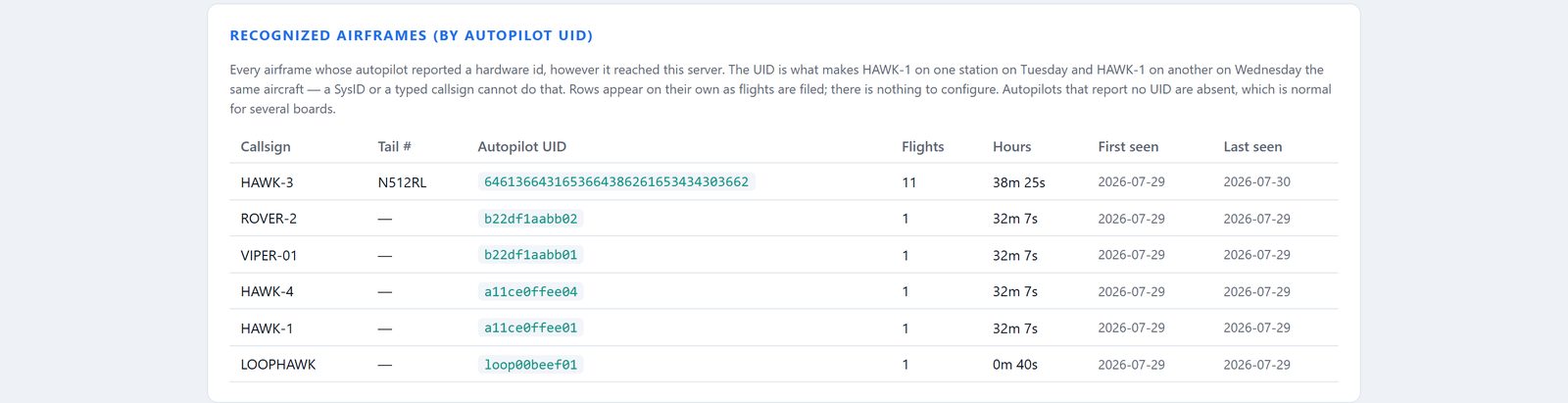
A table of recognized airframes keyed by autopilot hardware UID, each with callsign, tail number, flight count, accumulated hours, and first and last seen dates.
Aircraft are recognized by their autopilot's hardware UID, not by a callsign somebody typed — which is what makes HAWK-1 on one station on Tuesday the same airframe as HAWK-1 on another on Wednesday. Rows appear on their own as flights are filed, and the hours are real flown time.
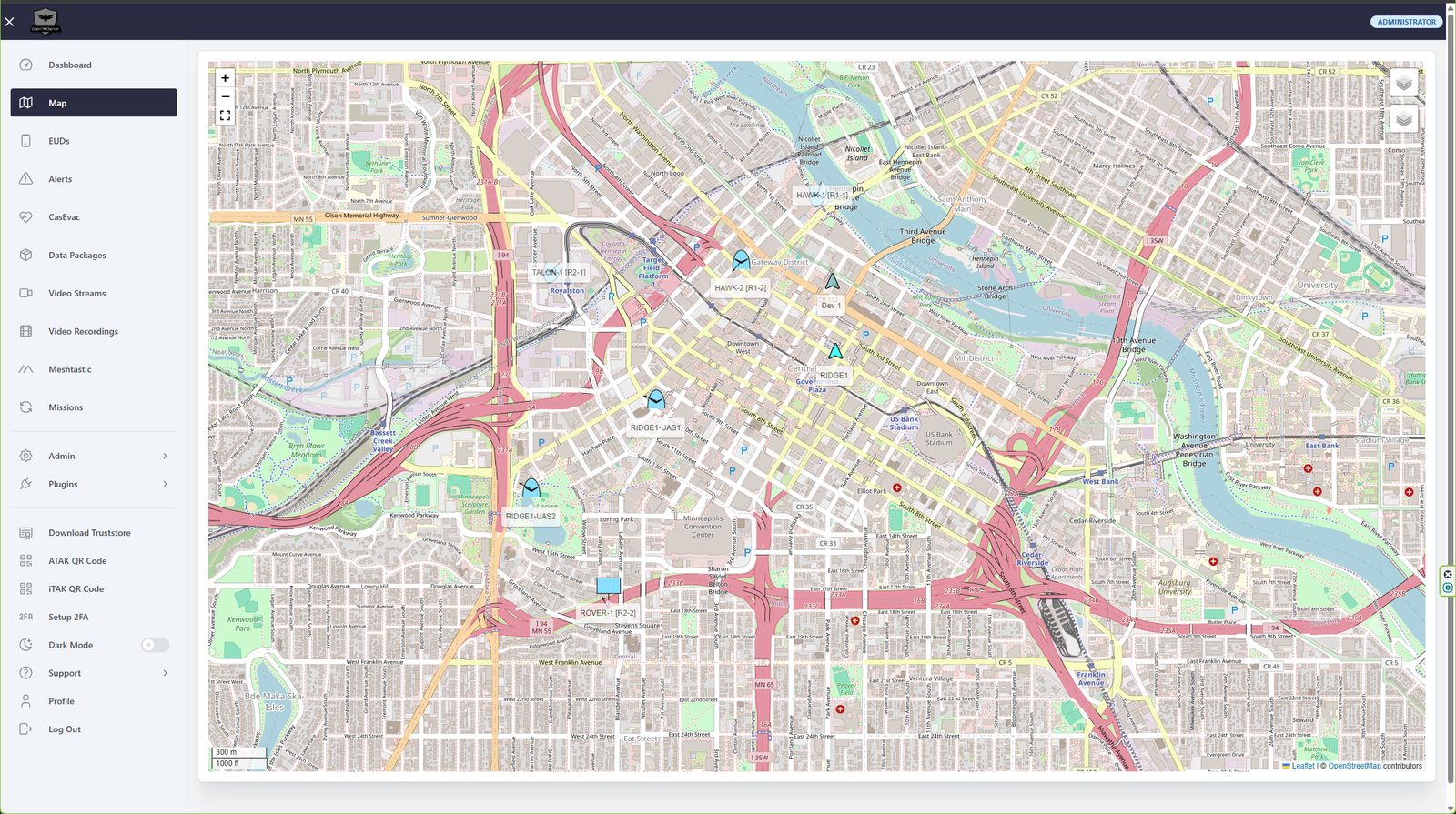
An OpenTAKServer map showing six live tracks over a city: RIDGE1-UAS1, RIDGE1-UAS2, HAWK-1, HAWK-2, TALON-1 and ROVER-1, each labelled with its crew address.
And the same fleet on the map your team already has open. Standard Cursor-on-Target — here on OpenTAKServer, and identical in ATAK.

Fleet Server Cloud

Not a product and nothing to buy. It is a menu item inside Fleet Server: paste a RotorLab Device Key and the connection to RotorLab switches on.
FLEET SERVER CLOUD rl_895bEDCo… RotorLab Device Key Roster and registry sync Flight filing, keyed so a retry never duplicates Checklist completions against those flights The log file, kept with the flight
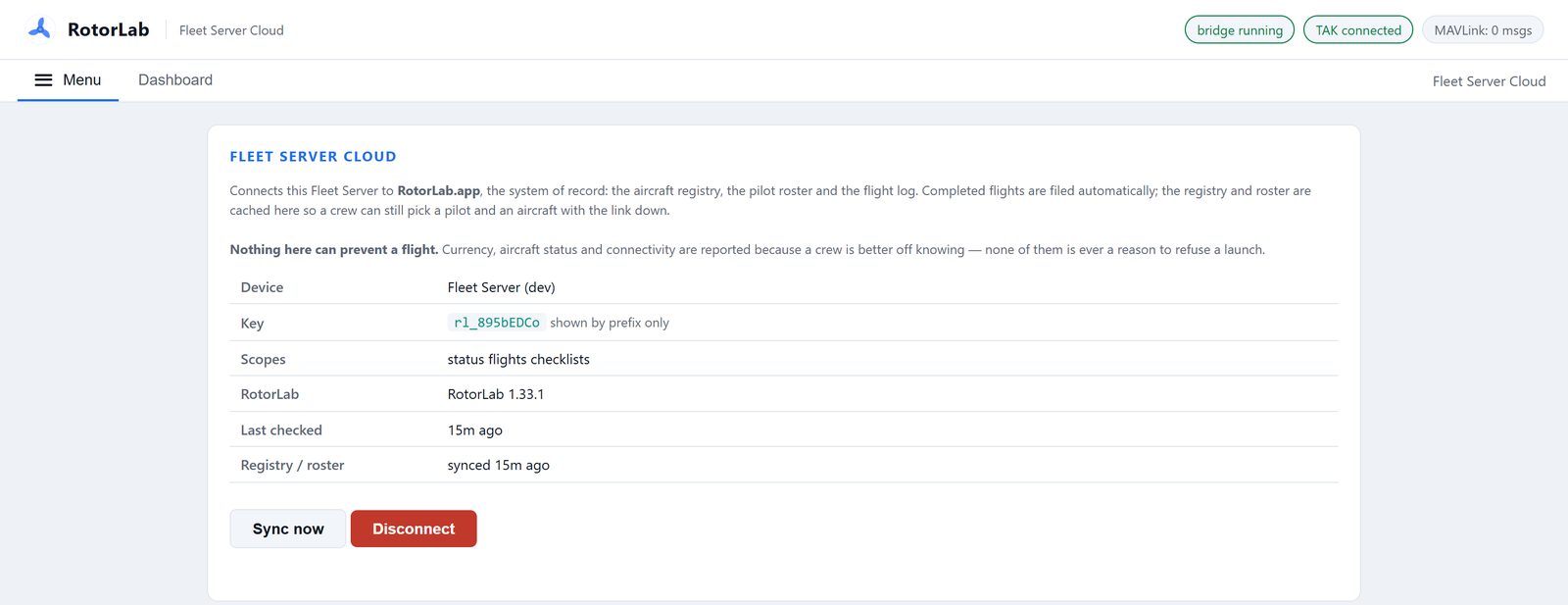
The Fleet Server Cloud screen: connected to RotorLab.app, showing the device key by prefix only, the scopes it holds, the RotorLab version and when the registry and roster last synced.
The menu item itself. The key is shown by prefix only, its scopes are named, and the first line under the title is the rule the whole product is built on: nothing here can prevent a flight.
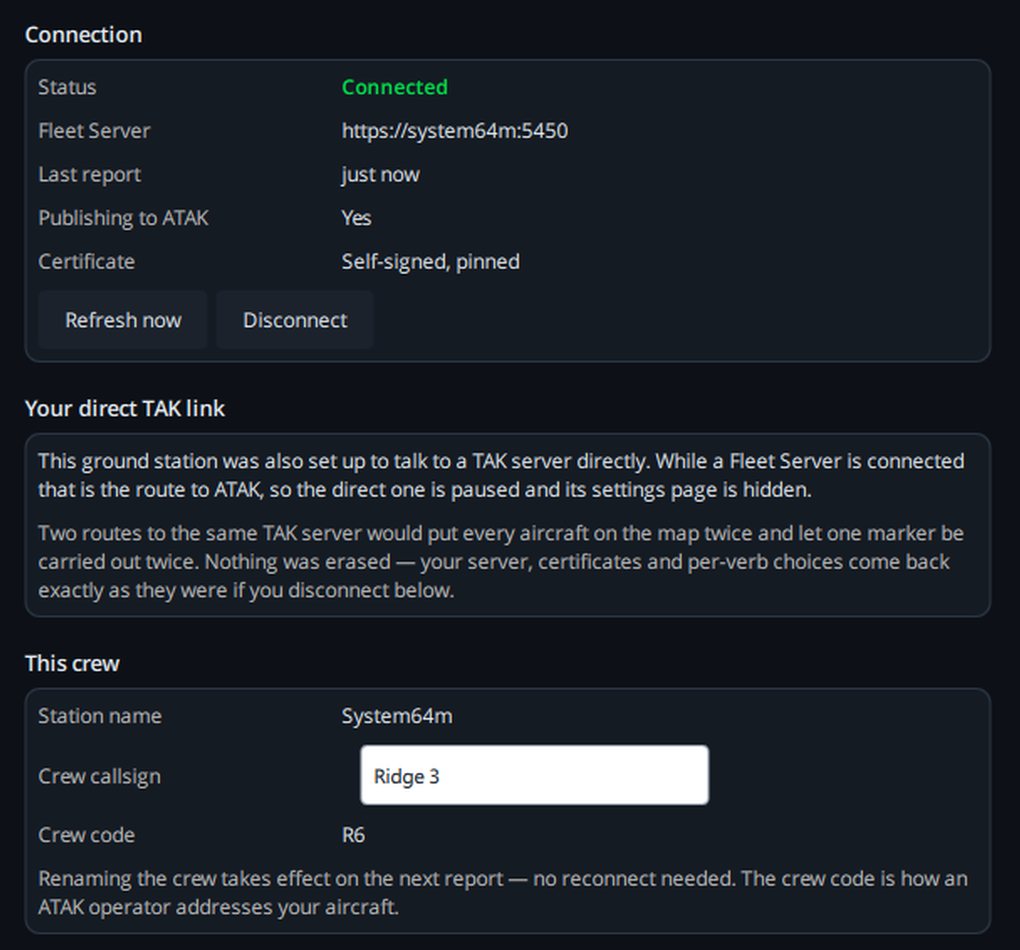
The Fleet Connector screen in RotorLab GC: status Connected to a Fleet Server, publishing to ATAK, with the crew callsign and crew code shown.
A ground station with the Fleet Server connected. One route to ATAK, one crew callsign, and a crew code an ATAK operator can address.
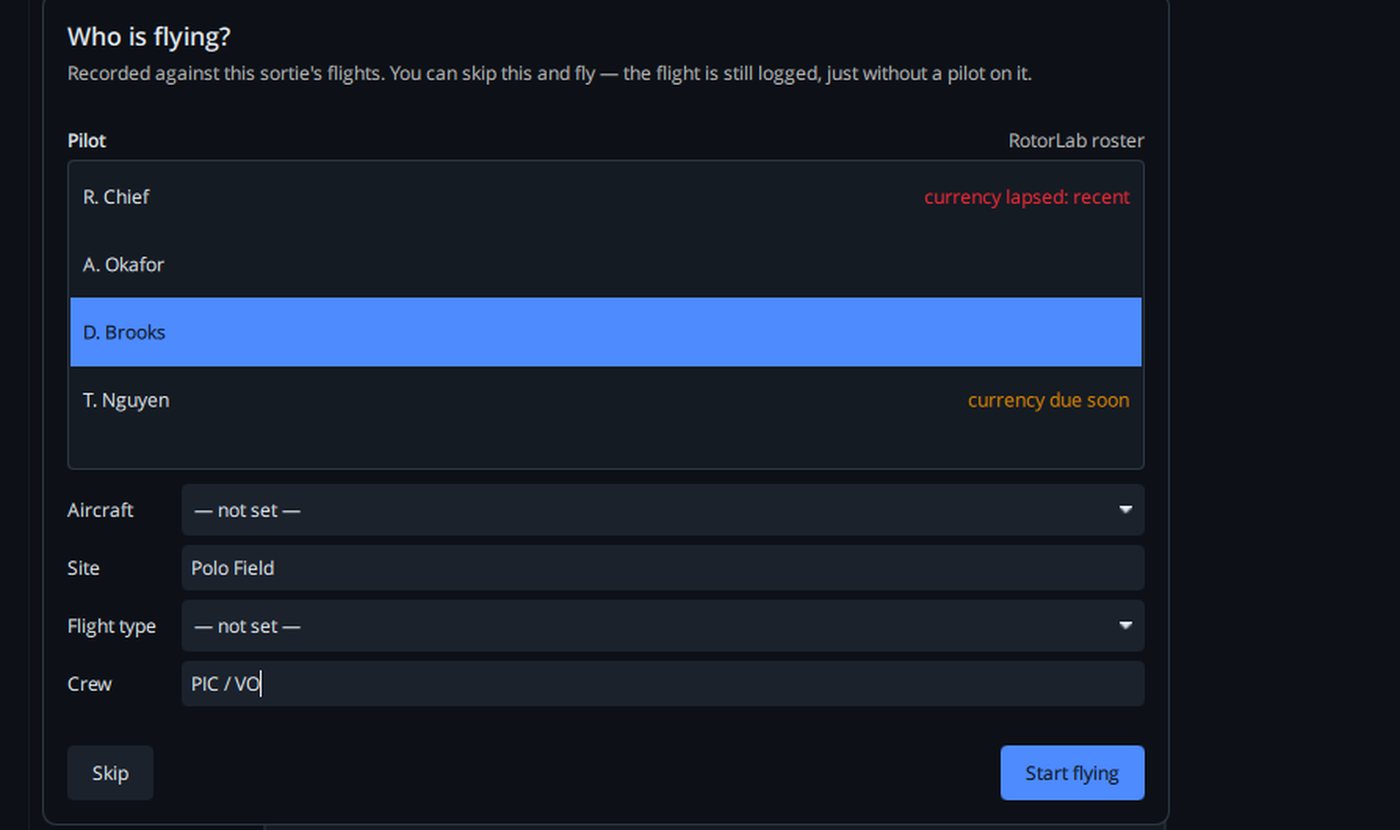
The Who is flying dialog on a ground station, listing pilots from the RotorLab roster with currency lapsed and currency due soon warnings beside two of them.
Your RotorLab roster, at the launch point — currency warnings and all. The crew can still skip it and fly; the flight is logged either way.

What it will never do

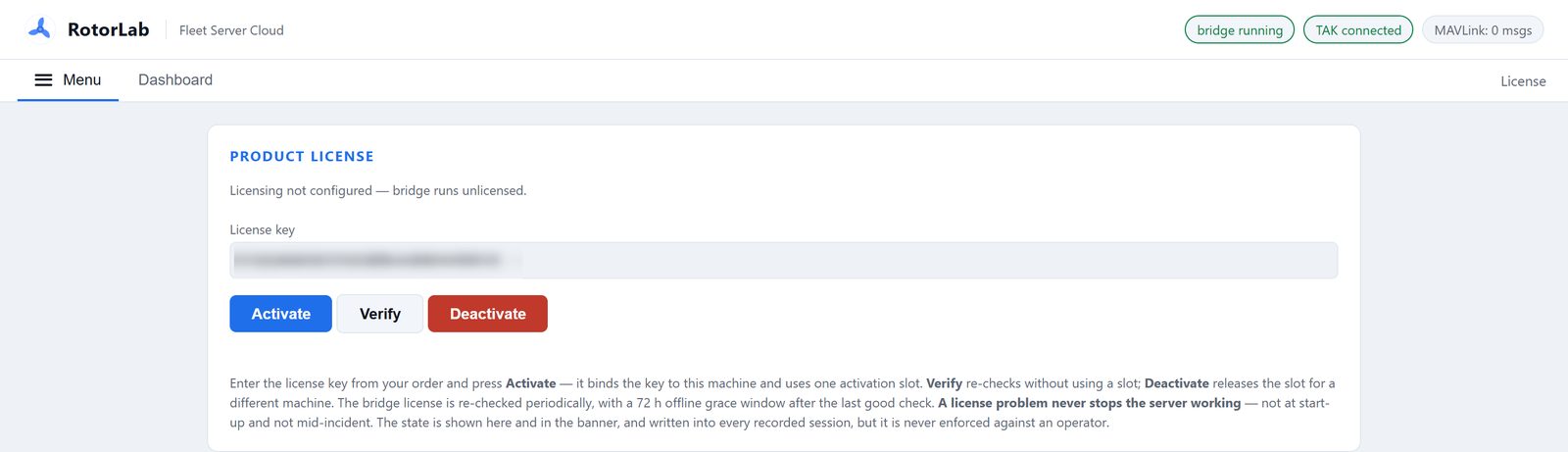
The product licence screen: a licence key field with Activate, Verify and Deactivate, and a note that a licence problem never stops the server working.
Activate binds a key to a machine; Deactivate frees the slot for another one. The licence is re-checked with a 72 hour offline grace window — and a licence problem never stops the server working, at start-up or mid-incident. (Key obscured here.)
Licence keys are issued through the shop rather than this site's checkout. Tell us what you fly and we will size it with you — request a quote.
RotorLab.app RotorLab GC Fleet Server MAVLink/ATAK Bridge Request a quote