 RotorLab
When the work crosses a border, the record-keeping usually does not. RotorLab keeps flights, aircraft and pilots the way operators do in the United States, the United Kingdom, the EU, Canada, Australia, New Zealand, Japan, South Africa, India, Brazil and Singapore — so winning the job abroad costs you a flight, not a second system and a spreadsheet nobody trusts.
Pick where the flight was flown and the form asks that country’s questions. Your crew learns one system, you pay for one subscription, and the record is right in both places without anybody keeping a side spreadsheet to catch what the software missed.
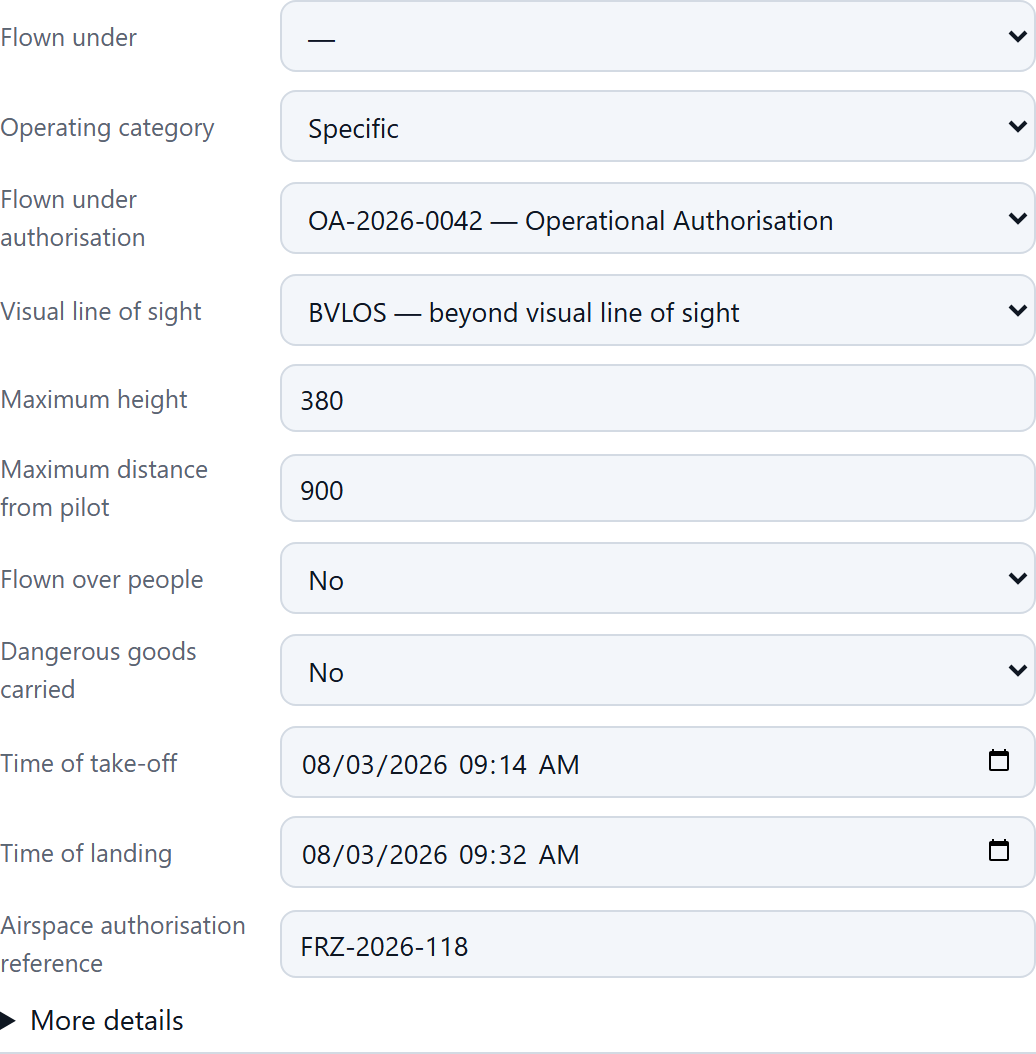
United Kingdom — Specific category, BVLOS
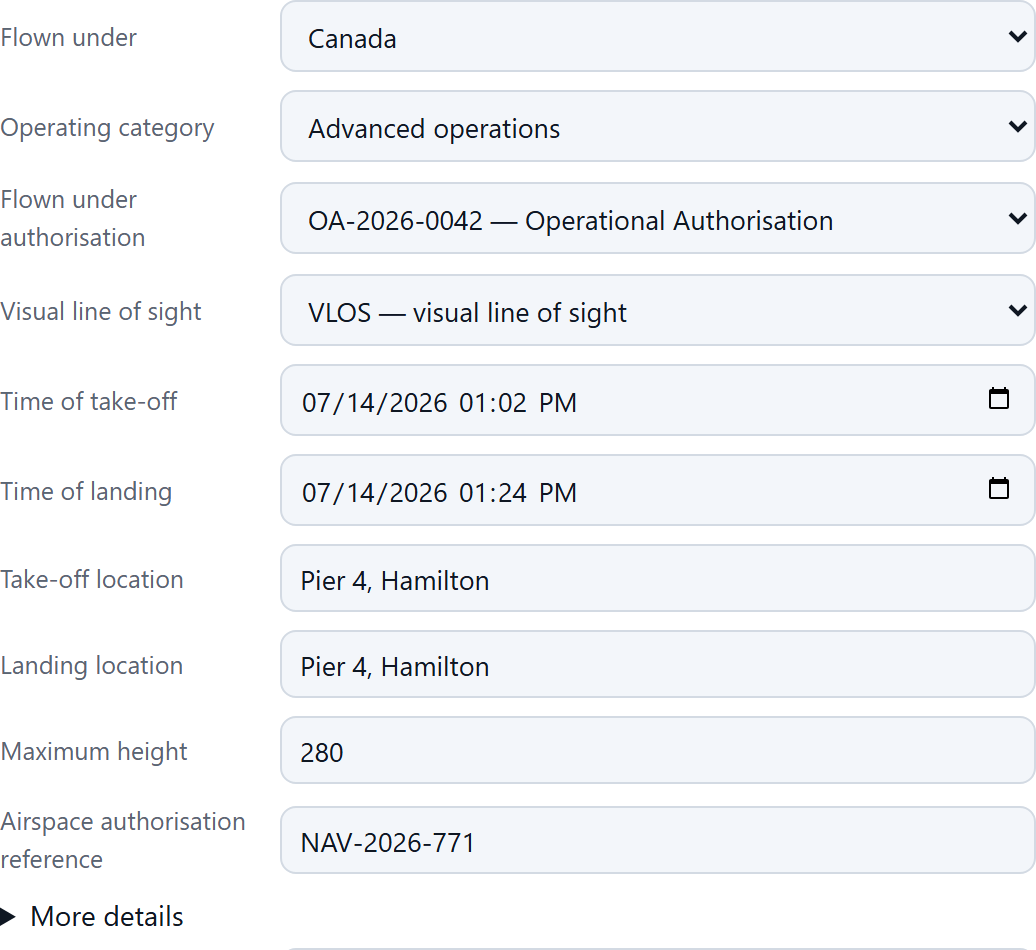
Canada — Advanced operations
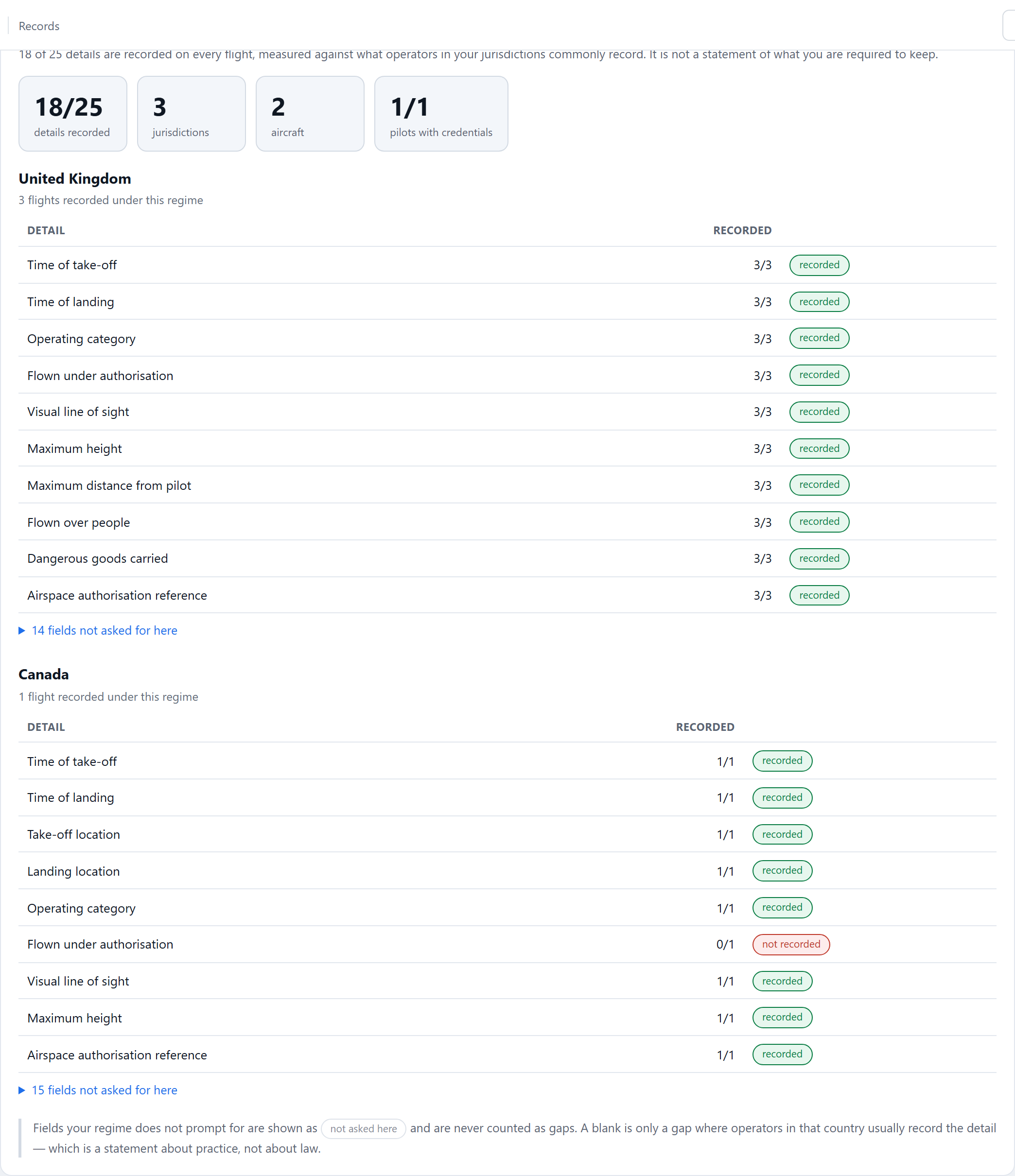
One gap in Canada, found before anyone asked for it.
Nobody discovers a missing record at a convenient moment. It turns up when an insurer asks for the file, when a client wants proof before releasing the next job, or when a regulator picks a date at random. This page tells you first — every detail recorded, partly recorded, or not recorded, per country.
A pilot working both sides of the Atlantic carries a Part 107 certificate, a Flyer ID and an A2 Certificate of Competency — three authorities, three renewal dates, and only one of them has to lapse to stop a job on the morning it was booked. RotorLab holds all of them and puts whatever expires first at the top.
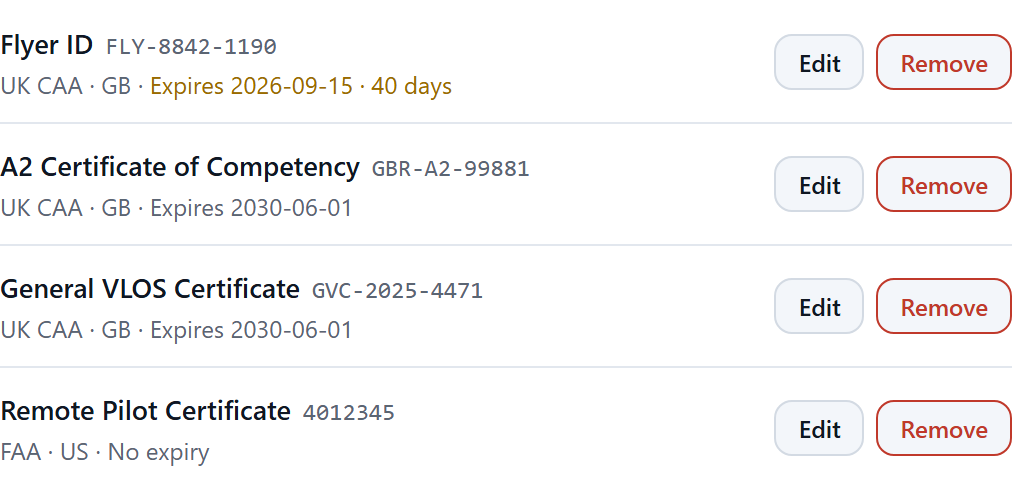
Four credentials, two countries, one pilot.
Each country names things differently — the tier you operate in, the permission you hold, what a pilot carries. RotorLab knows all of it, so taking work in a new market is a commercial decision rather than a systems project.
| Country | Authority | Framework |
|---|---|---|
| United States | FAA | 14 CFR Part 107 |
| United Kingdom | CAA | UK Reg (EU) 2019/947, CAP 722 |
| European Union | EASA and the national authority | Reg (EU) 2019/947 and 2019/945 |
| Canada | Transport Canada | CARs Part IX |
| Australia | CASA | CASR Part 101 and the Part 101 MOS |
| New Zealand | CAA NZ | Civil Aviation Rules Part 101 / 102, CATI 101-1 |
| Japan | JCAB / MLIT | Civil Aeronautics Act |
| South Africa | SACAA | CAR Part 101, SA-CATS 101, CAR Part 71 |
| India | DGCA | Drone Rules 2021 |
| Brazil | ANAC | RBAC nº 100 |
| Singapore | CAAS | Air Navigation Act 1966; ANR-101 Regulations 2019 |
Flying somewhere else? You get every field, with nothing assumed — so you record exactly what your regulator asks for from the first flight, and edit the wording to match. Tell us where you fly and it goes on the list.
Keep records too briefly and you cannot answer; keep everything forever and you cannot find anything. Set a window per record and RotorLab tells you what is past it — then stops. Nothing is deleted on a timer, because the file an auditor asks for is always the one that just aged out.
Outside the US an occurrence comes with a clock. Record the deadline, when you filed, how, and the reference you got back — so the answer to “can you show us?” is a document, not a memory and a hope.
RotorLab is written in English, aviation's working language — and every page is built to translate cleanly with the translation your browser already has (Chrome, Edge and Safari all offer it on any page). Registrations, serials, link codes and verification codes are marked to stay exactly as written, so what must be retyped or checked never gets mangled. Documents of record — dossiers, binders, published manuals — stay in the language they were signed in, because a translation is a different document.
Manual sections in the words your regulator uses, not an American document with the place names swapped — United States, United Kingdom, EU, Canada, Australia, New Zealand, Japan, South Africa, India, Brazil and Singapore. Start from an outline or from a blank page, write sections we never thought of, order them the way your authority reads them — it comes out as your programme's manual, not our template with your name on it. Corrections reach you as a notice, never as a silent edit to something you already approved.
Regulators keep changing what operators have to record. We track those frameworks and keep RotorLab aligned to them — the fields, the vocabulary, the manual sections, the reports. Eleven today, and the list keeps growing.
Your job is flying. Ours is making sure that when somebody asks what you did, the answer is already on file and stands up.
RotorLab keeps the record and shows its working. It is not legal advice, and what the law asks of you stays yours to determine.
Flight physics, fleet operations and what shipped — written for people who fly. No spam, unsubscribe in one click.